

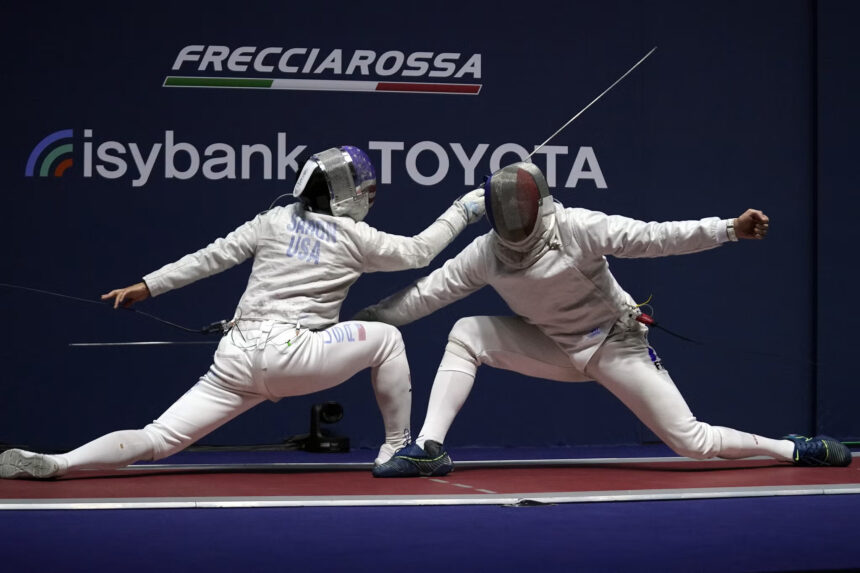
Fencing, the modern sport of sword fighting, is one of the world’s oldest competitive sports, combining speed, physical skill, lightning-fast reactions, tactical thinking and split-second decision-making.
- The Three Weapons of Fencing
- 1. FOIL – Precision Matters
- 2. ÉPÉE – The Whole Body Is the Target
- 3. SABRE – Striking with the Blade as Well as the Tip
- How Are Points Scored?
- Bout Duration and Scoring
- What Happens if the Scores Are Tied?
- The Piste – Where the Battle Takes Place
- How Do Team Events Work?
- The Referee’s Role
- Penalties and Cards
- FOIL – ÉPÉE – SABRE: The Difference at a Glance
- More Than Just Speed
Fencing has been an Olympic sport since the first modern Olympic Games in 1896. Today, international fencing competitions are governed by the International Fencing Federation (FIE).
At first glance, a fencing bout may appear to be nothing more than two athletes attempting to strike each other with swords. But behind every hit is a highly structured set of rules that determines whether a touch is valid and who earns the point.
The Three Weapons of Fencing
Fencing is divided into three disciplines:
- Foil
- Épée
- Sabre
Although the basic objective in all three is to score a valid hit on an opponent, each weapon has different target areas and rules governing how points are awarded.
1. FOIL – Precision Matters
Foil is a thrusting weapon, meaning a fencer must use the tip of the blade to make a valid hit.
The target area in foil is primarily the opponent’s torso. Hits to areas such as the arms and legs do not count.
One of the most important rules in foil is Right of Way, also known as Priority.
If both fencers appear to land a hit at almost the same time, the referee determines who had the right to score. The decision is based on factors such as who initiated the attack legally, whether the opponent successfully defended against it, and whether a subsequent attack was made.
Therefore, foil is not simply a test of speed. It is a highly technical and tactical discipline in which timing, precision and decision-making are crucial.
2. ÉPÉE – The Whole Body Is the Target
Épée is another thrusting weapon, with points scored using the tip of the blade.
The major difference from foil is the target area. In épée, the entire body is a valid target.
A fencer can score by landing a valid hit on the head, torso, arms or legs.
Unlike foil and sabre, épée does not use the Right of Way / Priority rule. Generally, the fencer who makes the valid hit first scores the point.
Another distinctive feature is the possibility of a double touch. If both fencers land valid hits within the relevant time interval, both can be awarded a point.
This makes distance control, timing and the ability to read an opponent’s movements particularly important in épée.
3. SABRE – Striking with the Blade as Well as the Tip
Sabre is often the fastest and most explosive of the three fencing disciplines.
While foil and épée primarily rely on thrusts with the tip of the weapon, sabre allows fencers to score using both the tip and the cutting edge of the blade.
The valid target area is mainly the upper body above the waist, including the head and arms.
Sabre also follows the Right of Way / Priority system used in foil. Therefore, even when the electronic scoring apparatus registers hits from both fencers, the referee must determine which attack had priority under the rules.
How Are Points Scored?
Modern international fencing competitions use electronic scoring equipment to detect hits.
The fencer’s weapon and other equipment are connected to the scoring apparatus. When a valid hit is registered, the machine produces a signal.
However, a signal from the scoring machine does not automatically mean that a point is awarded in every situation. In particular, in foil and sabre, the referee must determine the priority of the actions before deciding who receives the point.
Bout Duration and Scoring
In a standard pool bout, a fencer can win by reaching five points. If neither fencer reaches five points, the bout can end after three minutes of effective fencing time, with the fencer having more points declared the winner.
In direct-elimination bouts, foil and épée are normally contested over three periods of three minutes, with a one-minute break between periods.
A fencer who reaches 15 points before the time expires wins the bout.
In sabre, a one-minute break is taken when a fencer reaches eight points, after which the bout continues towards the 15-point target.
What Happens if the Scores Are Tied?
If the scores are level at the end of the allotted time, an additional one-minute sudden-death period may be used.
Before the extra period begins, one fencer is randomly awarded priority.
The first fencer to score a valid touch during the additional minute wins the bout. If neither fencer scores before the minute expires, the fencer who had been awarded priority is declared the winner.
It is important to note that this use of priority in overtime is not the same thing as the Right of Way rule used in foil and sabre.
The Piste – Where the Battle Takes Place
Fencers compete on a long, narrow strip called a piste.
If a fencer completely crosses the rear boundary of the piste, a point may be awarded to the opponent.
There are also specific rules governing movement beyond the side boundaries. Depending on the situation, a fencer may have their position adjusted or may receive a penalty.
How Do Team Events Work?
The scoring system in team fencing is different from that of an individual bout.
A team match normally consists of nine bouts, with a maximum score of 45 points.
The cumulative target increases throughout the match: the first bout is fought towards five points, the second towards 10, the third towards 15, and so on until the final bout, which is fought towards 45.
If neither team reaches 45 by the end of the ninth bout, the team with the higher score wins.
The Referee’s Role
The referee plays a crucial role in a fencing bout.
An electronic scoring signal alone does not determine the final outcome. The referee must decide whether an action was valid, whether a rule was broken and, in foil and sabre, which fencer had priority.
In sabre, for example, the FIE rules specifically place responsibility for determining the validity and priority of actions with the referee.
Penalties and Cards
Referees can impose penalties for rule violations during a fencing bout.
A Yellow Card generally serves as a warning, while a Red Card can result in a penalty hit being awarded to the opponent. In serious or specific cases of misconduct, a Black Card can lead to exclusion from the bout or even removal from a competition.
Penalties may be imposed for actions such as illegal physical contact, dangerous behaviour, unsporting conduct, improper protests against refereeing decisions and certain violations relating to the competition area.
FOIL – ÉPÉE – SABRE: The Difference at a Glance
FOIL
- Hits must be made with the tip of the blade.
- The main target area is the torso.
- Right of Way / Priority rules apply.
ÉPÉE
- Hits must be made with the tip of the blade.
- The entire body is a valid target.
- There is no Right of Way rule.
- A double touch can result in both fencers scoring.
SABRE
- Hits can be made with both the tip and the blade.
- The main target area is the upper body above the waist.
- Right of Way / Priority rules apply.
More Than Just Speed
In fencing, a fencer may have only a fraction of a second to read an opponent’s movement, defend against an attack, launch a counterattack or decide whether to retreat.
That is why fencing is far more than simply swinging a sword quickly. Footwork, distance, timing, reaction speed, defence, attack and tactical thinking all come together in this highly complex competitive sport.
The sword may be in the athletes’ hands, but the real battle on the piste takes place between their speed, strategy and ability to make split-second decisions.