
The Discus Throw is one of the major throwing events in athletics. The objective is simple: throw a heavy discus as far as possible from within a designated circle.
- An Event Thousands of Years Old
- The Weight of the Discus
- The Throwing Circle
- The Landing Sector
- How Many Attempts Does an Athlete Get?
- What Makes a Foul Throw?
- How Is the Discus Held?
- The Technique Behind a Discus Throw
- Release Angle and Flight
- Is Technique More Important Than Strength?
- Can Athletes Use Their Own Discus?
- World Records
- Where Strength, Speed and Science Come Together
At first glance, the event may appear to depend mainly on physical strength. But a successful discus throw requires a combination of strength, speed, balance, footwork, body rotation, timing and technical precision.
An Event Thousands of Years Old
The history of the Discus Throw can be traced back to ancient Greece. Historical records indicate that discus throwing was part of the Pentathlon at the ancient Olympic Games around 708 BC.
The event has also become one of the most recognisable images of ancient Greek art, with sculptures depicting athletes preparing to throw the discus becoming iconic representations of athleticism.
The men’s Discus Throw has been part of the modern Olympic Games since 1896, while the women’s event was added to the Olympic programme in 1928.
The Weight of the Discus
The weight of the discus used in international competitions varies according to the athlete’s age group and competition category.
For senior men, the discus weighs 2.000 kg.
For senior and U20 women, a 1.000 kg discus is used.
Male U20 athletes use a 1.750 kg discus, while the U18 men’s event uses a 1.500 kg discus.
A 1.000 kg discus is also used in the U18 women’s competition.
The discus used in senior men’s competitions generally has a diameter of between 219 and 221 millimetres, while a 1 kg discus has a diameter of approximately 180–182 millimetres.
The Throwing Circle
The inner diameter of the throwing circle used in the Discus Throw is 2.50 metres.
The athlete must remain within this circle while making the throw. Stepping outside the circle or illegally touching its boundary can result in a foul.
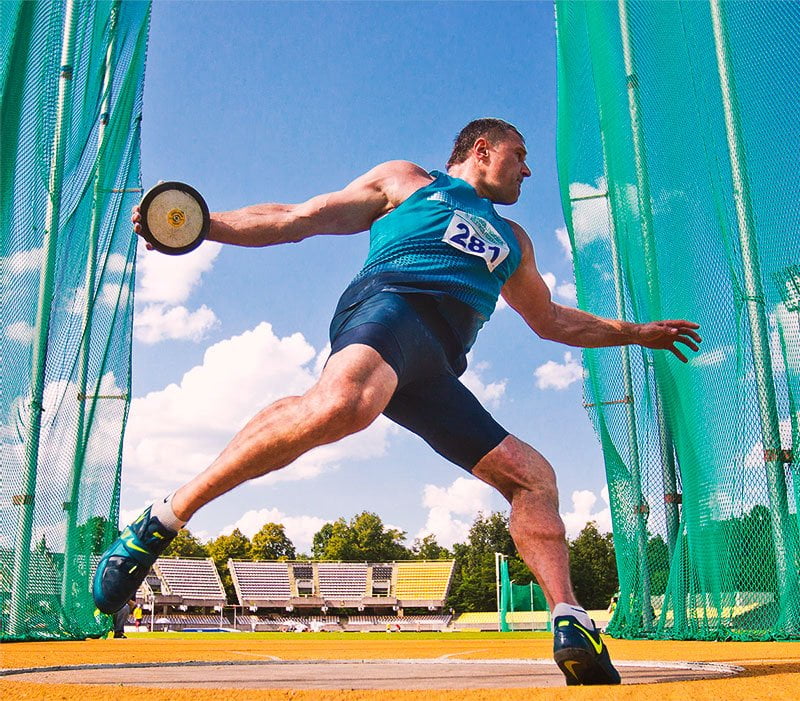
A protective safety net, known as a discus cage, is positioned around the circle. Its purpose is to protect athletes, officials and spectators from a discus travelling in an unintended direction.
The Landing Sector
The discus must first land within a designated 34.92-degree throwing sector.
If the discus first touches the ground outside the boundaries of this sector, the attempt is considered invalid.
The distance of a throw is measured from the nearest mark made by the discus on its first contact with the ground to the inner edge of the throwing circle.
How Many Attempts Does an Athlete Get?
In a standard international Discus Throw competition, each athlete initially receives three attempts.
The athletes with the best performances after the first three rounds are generally given three additional attempts. This means a finalist can have a maximum of six throws.
The winner is determined by the athlete’s longest valid throw.
If two or more athletes record the same distance, their next-best valid throw is considered to determine the ranking.
What Makes a Foul Throw?
Several rules must be followed during a discus throw.
An attempt can be ruled a foul if an athlete illegally touches the ground outside the throwing circle, if the discus lands outside the throwing sector, if the athlete leaves the circle before the discus lands, or if the athlete exits the circle incorrectly after completing the throw.
As a general rule, the athlete must leave the circle through the rear half after the discus has landed.
How Is the Discus Held?
The discus is not gripped tightly in the centre of the hand.
Instead, it rests lightly against the palm, with the fingers spread around the rim.
As the discus is released, it rolls off the fingers and gains rapid spin.
That spin is crucial for maintaining the stability of the discus during its flight.
The Technique Behind a Discus Throw
At elite level, discus throwers typically begin from the back of the circle and use a rotational movement of roughly one and a half turns before releasing the discus.
During this movement, force generated by the legs is transferred through the hips, torso, shoulders and throwing arm into the discus.
In an efficient throw, the power generated by the legs must be transferred sequentially from the lower body through the upper body.
The basic phases of a discus throw can be described as:
- Starting Position
- Wind-up
- Entry
- Rotation
- Power Position
- Delivery
- Release
- Follow-through
One of the key technical principles is allowing the hips to rotate ahead of the shoulders. This increases the rotational torque generated by the body and allows greater force to be transferred to the discus through the throwing arm at the moment of release.
This is why the Discus Throw is far more than an event based simply on arm strength.
Release Angle and Flight
Release speed is one of the most important factors determining how far the discus travels.
However, other factors also play a role, including release angle, release height, spin rate, the tilt of the discus, and the direction and speed of the wind.
A release angle somewhere around 35 to 40 degrees is commonly used by many athletes, although there is no single ideal angle for every thrower.
The optimal angle can vary depending on the athlete’s height, release speed, technique and weather conditions.
Is Technique More Important Than Strength?
Physical strength is essential for the Discus Throw. However, at elite level, strength alone is not enough.
An athlete may be extremely strong, but if they cannot maintain balance inside the circle, have poor footwork, mistime the rotation between the hips and shoulders, or release the discus at the wrong moment, achieving a long throw becomes difficult.
That is why discus throwers train strength, explosive power and technique together.
Training programmes may include exercises such as squats, Olympic lifts, medicine-ball throws, rotational strength exercises, footwork drills and release drills.
Can Athletes Use Their Own Discus?
At international competitions, the required throwing implements are generally provided by the organisers.
However, depending on the competition regulations and subject to approval by the technical officials, an athlete may be permitted to submit their own discus for use in the competition.
Such a discus must be inspected before the competition to ensure that it meets the required specifications.
Once approved, it may also have to be made available for use by other athletes in accordance with the competition rules.
World Records
The men’s Discus Throw world record belongs to Mykolas Alekna of Lithuania.
In April 2025, Alekna set the world record with a throw of 75.56 metres.
The women’s Discus Throw world record is held by Gabriele Reinsch of Germany, who threw 76.80 metres in 1988.
Although the women’s record is longer than the men’s record, the two performances cannot be directly compared.
One major reason is the difference in equipment: senior men compete with a 2 kg discus, while senior women use a 1 kg discus.
Where Strength, Speed and Science Come Together
Although the Discus Throw is one of the oldest events in athletics, it has evolved into a highly technical and scientifically driven discipline.
Within just a few seconds, an athlete must generate power from the legs, rotate the body at high speed, maintain balance and release the discus at precisely the right moment.
Ultimately, the distance of a discus throw is not determined simply by how hard the athlete throws.
It is about how effectively the athlete transfers the power of the entire body into the discus — with speed, precision, timing and flawless technique.